


Although Uber and Airbnb were successful, most sharing economy companies were either successful but smaller than expected, like Turo, or failures, like SnapGoods. In other words, the sharing economy failed.
It is simple to understand why. The sharing economy was predicated on monetizing slack time in assets—we’ve all heard the riff that cars are parked 95% of the time. Uber worked because cars were valuable enough to justify driving, but most other sharing economy companies failed because they required too much effort.
Waymo, and self-driving cars, are going to change this and transform our economy into ones where our consumer goods become true assets generating passive income.
The Economics of Sharing Cars
The sharing economy bifurcated in two ways. The companies that worked generated cash streams that were high enough to be someone’s actual job because they involved the two most expensive assets people own, their homes and their cars, in transactions that happened frequently enough to justify the effort. On the other end were assets that were not valuable enough or frequently used enough to generate cash streams high enough to replace your job. Those assets need to be basically passive to justify the investment, which means the transaction costs need to be low. That last part is where the sharing economy failed: it turns out most assets aren’t that valuable to monetize, and the fixed transaction costs made monetizing them anything but passive.
What we got instead was mostly the gig economy. Companies that made it easier to monetize your time, not your stuff, were what actually took off. Rent the Runway has never posted a profitable fiscal year, but Fiverr went public; E Umbrella went bankrupt due to theft, but Taskrabbit was bought by Ikea for a billion dollars. The sharing economy, in this way, did work—it just required us to still be part of the equation. The big kahuna here, of course, was Uber. It allowed people to monetize their cars, but it still required them to have the spare time to drive. In fact, for a long time, this was part of Uber’s marketing to drivers.
Many fear that Waymo will lead to a loss of jobs. While it clearly will in the driving world, it will actually lead to a net increase of jobs, and more importantly, give those drivers passive income.
Waymo is obviously a new paradigm. Waymo’s cars have already driven over 96 million miles this year and are already over 90% safer than humans, according to their insurance provider Swiss Re. The cost curves have hardly even begun to come down and Waymo’s hardware costs are already just 30 cents per mile, according to its CEO, compared to $2-3 for Uber and Lyft. Add in extraordinary utilization rates—according to Uber, Waymos are in the 99th percentile compared to human drivers—and you have a moneymaking machine on your hands. Waymo has a mere 800 vehicles in operation in the Bay Area compared to tens of thousands of rideshare drivers and is already bigger than Lyft. But Waymo isn’t going after the rideshare market, of which it currently controls about 25%, but total miles driven, which is about 5 times bigger in San Francisco (and lower elsewhere in the Bay). In other words, Waymo is just at 5% market share of total vehicle miles. That will require quite a few cars! No wonder Waymo is exploring personal vehicle systems, starting with Toyota. Of course they are—this will drive economies of scale for sensor components like LiDAR and help satisfy consumer demand.
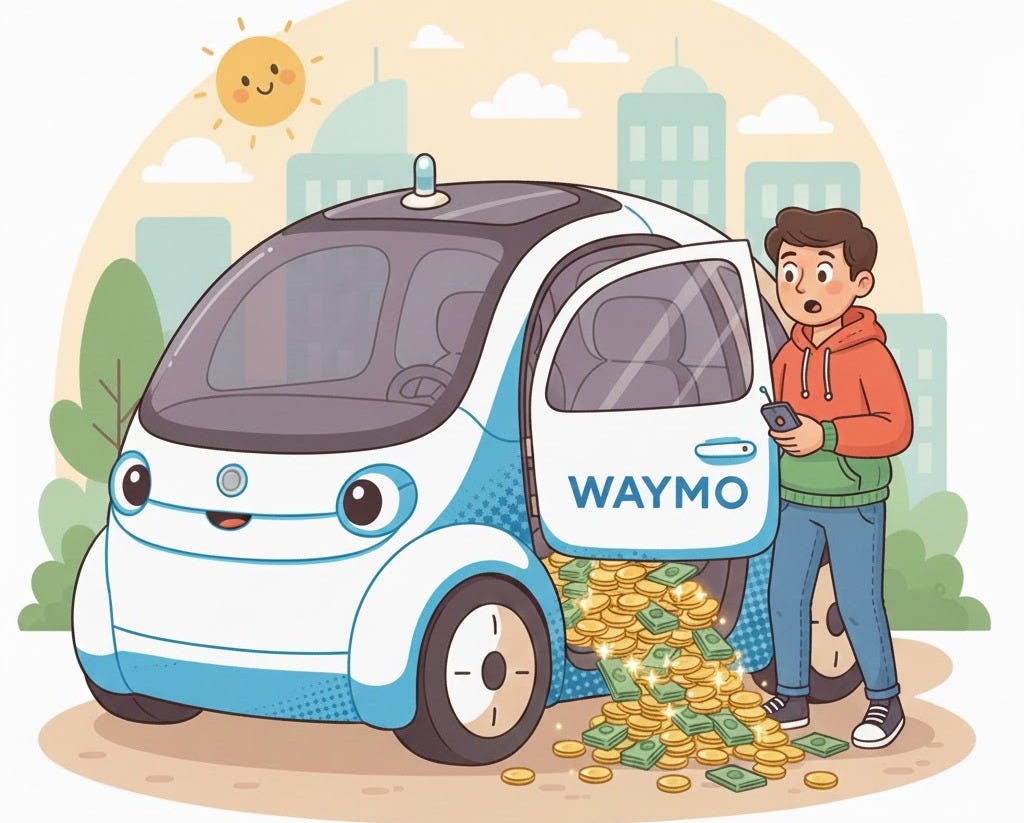
This will also obviously lead to the ability for people to rent out their cars on the Waymo network in exchange for revenue share net of operating costs, namely cleaning, maintenance, and refueling. Waymo will welcome this. The reason asset light is such an appealing business model is that it is also liability light. For cars especially, auto loans are generally lower for personal use. Consumers will welcome this too. Right now, the average Waymo generates about $200 in revenue per day, or $6000 per month. The average consumer auto payment is just $748.1
Even though the cost of a Waymo will go down, and even though there will be maintenance costs, the math still pencils out for consumers. Say there is a 50% gross profit—that’s still $3000 per month, far exceeding the monthly car payment. Yes, prices will go down from here, but utilization will go up, resulting in a wash if not a modest increase. That means an extra $1000-2000 of spending money a month, not to mention a paid-off car for when you want to use it.
Uber drivers will also love this—the vast majority of them are part-time, meaning that Uber is a part-time second job. The only thing better than making money from a second job is making money passively.
Waymo will also result in new jobs for the 9% of ex-Uber drivers who are currently full time (on top of the new passive income stream!). People won’t rent their cars out unless it comes back clean, which will create enormous demand for logistics jobs and cleaning jobs. Cleaners make $20-30 an hour, while the average Uber driver in California makes $21 an hour with more risk. These cleaning jobs will certainly command a premium because the required standards will be very high. Furthermore, because Waymos will be a replacement for all cars, not just rideshares, the logistics demand will be significantly higher than if Waymo merely replaced Uber.
Not Just Driving
That’s not the end of the passive income story, however.
Waymo will be so transformative that it will also lead to the creation of new, monetizable assets. The most obvious one is garage conversions. With self-driving cars shuttling around, it will not make as much sense to have parking in offices and homes. Today, it is standard for building codes to require parking. That is going to go away. It’s already starting to. When that happens, you’re going to see a wave of garage conversions. Who wouldn’t want all that extra space? A garage takes up 12-15% of a home’s square footage, and 55% of people already do something else in their garage like exercise or work. Today, a garage is needed to support your home value, but it won’t when you and your guests don’t need to park. That converted space will also be monetizable. How many of those new rooms will be Airbnbs? How many converted office parking spaces will have popups or logistics centers?
This won’t just apply to Waymo. The general idea of our devices getting smart is going to apply to more of our personal possessions. Expensive personal robots are coming into our homes. Ultimately, they will suffer from the same utilization problem that cars do. They’ll be too useful not to have, but lay dormant 90% of the time (there’s only so much cleaning to do). If your robot is as expensive as your car,2 you’re going to want to rent it out. Yet more passive income.
Even here, Waymo itself rears its lovely head. If you want to rent out your Sunday Robotics cleaning robot during its downtime, without cost-effective logistics, you won’t be able to make any money. With Waymo, the cost of shuttling your cleaning robot drops 80-90% and can be done on-demand with little to no input from you. This not only drives more income and utilization for those rented out Waymos—it creates a business model for Sunday Robotics and allows its customers to monetize more of their assets.
The Golden Future
This passive income is coming just in time, too. It is a sort of market-enabled UBI just as a giant productivity boost is coming that is going to reduce the amount we work significantly.
Like it or not, the four day work week is already here. According to Ari Emmanuel, the top day for booking hotels is now Thursday, not Friday. In a few years, intelligence from LLMs to AVs will bring us to a three-day workweek. This is what happened during the Industrial Revolution too. Productivity increases led to a steady decrease of work by 4 hours per week each decade, going from an average of 69 hours per week in 1830 to 42 hours by 1930. By the time the 40-hour work week became law in 1938, “Fordism” was already the norm.3
The passive income society will help power this. It will also help people get started or get by during hard times. While we often focus on get-by jobs, like driving a cab or serving coffee, people also make money by renting out their stuff. The comedian Andrew Schulz, for example, sublet his apartment and slept in his closet while he was getting started. This is what will replace the low barrier to entry “getting by” jobs: low cost of entry “getting by” assets.
The new consensus is that political opposition to AI is coming from the AI industry not doing enough to explain the benefits of their vision. This vision is clear: AI will make us safer, work less, and turn the average person into a rentier.
The passive income society can’t come soon enough!
For those in the back who say “but a Waymo costs $200,000!”, I have two things to say: (1) this is a quote from like five years ago and is already outdated as the cost of the sensor package has fallen by 15x; and (2) obviously, the low-production volume, custom Jaguar cars are going to cost more than the budget Hyundai cars with mass-produced sensor packages that will be the norm in 2 years.
People will need something to do, and they will also want to supplement their income. What David Graeber calls “bullshit jobs” will disappear because the productivity gains will go from slowly creeping into a liminal space—enough to increase TFP, but not enough to justify changing our work cadence—to sudden and transformative. I’ve never believed in the idea of bullshit jobs, but it is interesting that they coincide with increasing productivity. I suspect the reason for this is that, while very few jobs are bullshit, our jobs include an increasing amount of bullshit in them. It is because productivity has increased to the point where many people, if not most, do not need to fill their full working week with being in the office, but the change is not enough to yet justify cutting an entire work day. Productivity changes are continuous, while workday-cutting is discrete, meaning that there are points where the “work” doesn’t equal the Work until it finally makes sense to make the jump, leading to a discontinuity.